
|
|
�None but the Brave Deserve the Fair.�
(Scene - Room in a public-house, near Bridgeton Cross. Time - Saturday night. Dramatis personae - Two working men.)
First - Hae ye been tae the Wild West Show yet, Tam?
Tam - Na, man, a�ve nae great thocht of gaun ether. The wife�s feared I wid com� hame scalpit.
First - Auch; thur�s nae fear o� that. The injuns are as tame as rabbits. D�ye ken a saw yin o� thum in his full war
pent, blanket an� a�, airm an� airm, in Duke Street, the ither nicht, efter the performance, wi� as bonnie a white
lassie as ever ye clappit e�en on. Ay, she wis a regular beauty; dressed up tae the nines tae, wi� her yellow hair
hingin� frae below a nate wee hat. Man a� just fare envied the redskin.
|
The Bailie for Wednesday, December 9th, 1891
|
|
|
On the occasion of the first Scottish visit of Buffalo Bill�s Wild West, Glasgow was the sole venue. The show
secured a residency of more than three months, finally concluding on Saturday, 27th February 1892, at the
recently vacated East End Exhibition Buildings in Dennistoun, secured by lease and specially converted into a
7,000 seater amphitheatre. The entourage had completed an engagement in Croydon, near London, on Saturday,
24th October, and proceeded to Glasgow by train immediately thereafter. The opening night finally took
place on Monday, 16th November 1891, after a succession of �vexatious delays� had forced repeated
postponements, whilst an army of workmen battled round the clock with the extensive preparations.
|
|
The show which caused such a sensation in the city that winter was entitled The Drama of Civilization. By
means of a series of tableaux grouped into six dramatic episodes, it presented a highly culturally biased view of
the manner in which �civility� had supposedly triumphed over the primordial chaos of paganism and anarchy over the
course of several centuries of American history.
|
|
It goes without saying that the Indians were vilified as the villains of the piece, and that the near destruction of
their culture was represented not merely as an unfortunate side-effect but as the crowning glory in the triumphant
and inexorable outcome of the process of cultural evolution.
The front cover of
the programme for
Season 1891-92
|

|
Included in the programme were Indian attacks on a wagon train, a ranch, and the Deadwood stage. On each occasion,
Buffalo Bill and his scouts and cowboys would ride to the rescue, scattering the �Redskins� in confusion. The
essential themes of subsequent Hollywood mythology were already in place.
Cowboys demonstrated feats of horsemanship - already well established as enduring elements in the Wild West show�s
brand of entertainment - picking up objects from the ground while riding at a gallop, the throwing of the lasso,
and the riding of bucking broncos.

|
Exhibitions of markmanship were given by Buffalo Bill himself, C.L. Daly the pistol and revolver
expert, Johnny Baker, and best of all, the Wild West show�s ever-popular star attraction, Miss Annie
Oakley, seen here in a line drawing from the Evening Times, 9th November 1891.
|
Highly innovative special effects were used to great effect, to simulate a prairie fire and a cyclone. This time
around, there was even a small herd of buffalo.
An unpardonable piece of historical revisionism provided the undoubted high point of the entertainment. This came
with a re-enactment of the Battle of the Little Bighorn, billed in the programme as The fall of brave
General Custer and his entire command. The famous Indian victory was almost inexplicably presented as an
�ambush� by the Indians, without any indication in the context of the show that the Indians themselves were in their
fight to save the sacred Black Hills the victims of an aggressive and unprovoked war of conquest.
One essential respect in which the Wild West show was definitely better than anything that Hollywood could offer was
that the Indians were authentic. They were genuine Lakota (more popularly known as Sioux), recruited from the
various reservations of South Dakota. Providing particular immediacy and interest was the participation of such
noteables as Kicking Bear and Short Bull. Both had been formidable warriors in their time, and were
veterans of the Custer battle of 1876. A third prominent member of the Indian contingent was No Neck, who had
been a leader of the �friendlies� assisting the federal government during the Ghost Dance outbreak.
|
The key figure of Kicking Bear in particular is worthy of closer attention as a historical figure. A first
cousin of the great Crazy Horse, he was the medicine man who, along with Short Bull and several
others, had travelled into the distant west, to Nevada. There they met with the Paiute mystic Wovoka, and
brought back the Ghost Dance cult to the Lakota reservations. On 15th January 1891, Kicking Bear became
the last Lakota warrior to surrender to the Federal government, at the end of the hostilities which had sporadically
ensued in the wake of the massacre at Wounded Knee. Almost incredibly, by the close of the same year, Kicking
Bear had become a familiar figure on the streets of Glasgow.
|
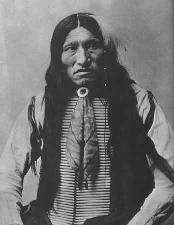
Kicking Bear
|
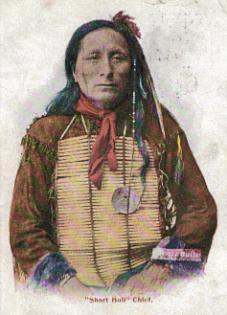
A rare colour version of Short Bull�s Fort Sheridan mugshot
|
Kicking Bear and Short Bull then had been the main instigators of the �Ghost Dance� uprising of just one year prior
to the their enforced Glasgow sojourn and travelled with the show among a number of prisoners of war who had been
presented with the option of joining Cody�s entourage as an alternative to continued imprisonment at Fort
Sheridan.
After the disturbances ended, it served the white authorities only too well to have the leading figures in the
recent �rebellion� out the way. It was too good an opportunity to be missed. The prospects of a further outbreak
were very much diminished, with the additional benefit that a period of exile into the heartland of the world of the
white man served to impress upon the minds of the Indians the futility of continued resistance.
|
Enduring local myths continue to insist that Sitting Bull (died 1890), Wild Bill Hickok (died 1876),
and even the Apache leader Geronimo came to Glasgow with Buffalo Bill but these are without proper
foundation. The first two had certainly been closely involved with Cody in earlier phases of his show business
career but both of these associations had long since been terminated by 1891.
In fact, during December 1890, Buffalo Bill, back in South Dakota for what proved to be the final Indian war, had
made a peace mission of his own to avert the looming catastrophe but his efforts to confer with his old friend
Sitting Bull were thwarted by the military. The legendary Lakota chief was killed shortly afterwards, on
15th December, when an attempt by reservation police to take him into custody went badly wrong. By the
time that this confused period of Western history came around, it was not always immediately apparent just what was
theatre and what was actually real.
Predictably, the 1891-92 sojourn proved to be highly eventful, and the principal incidents are now outlined on a
month by month basis: